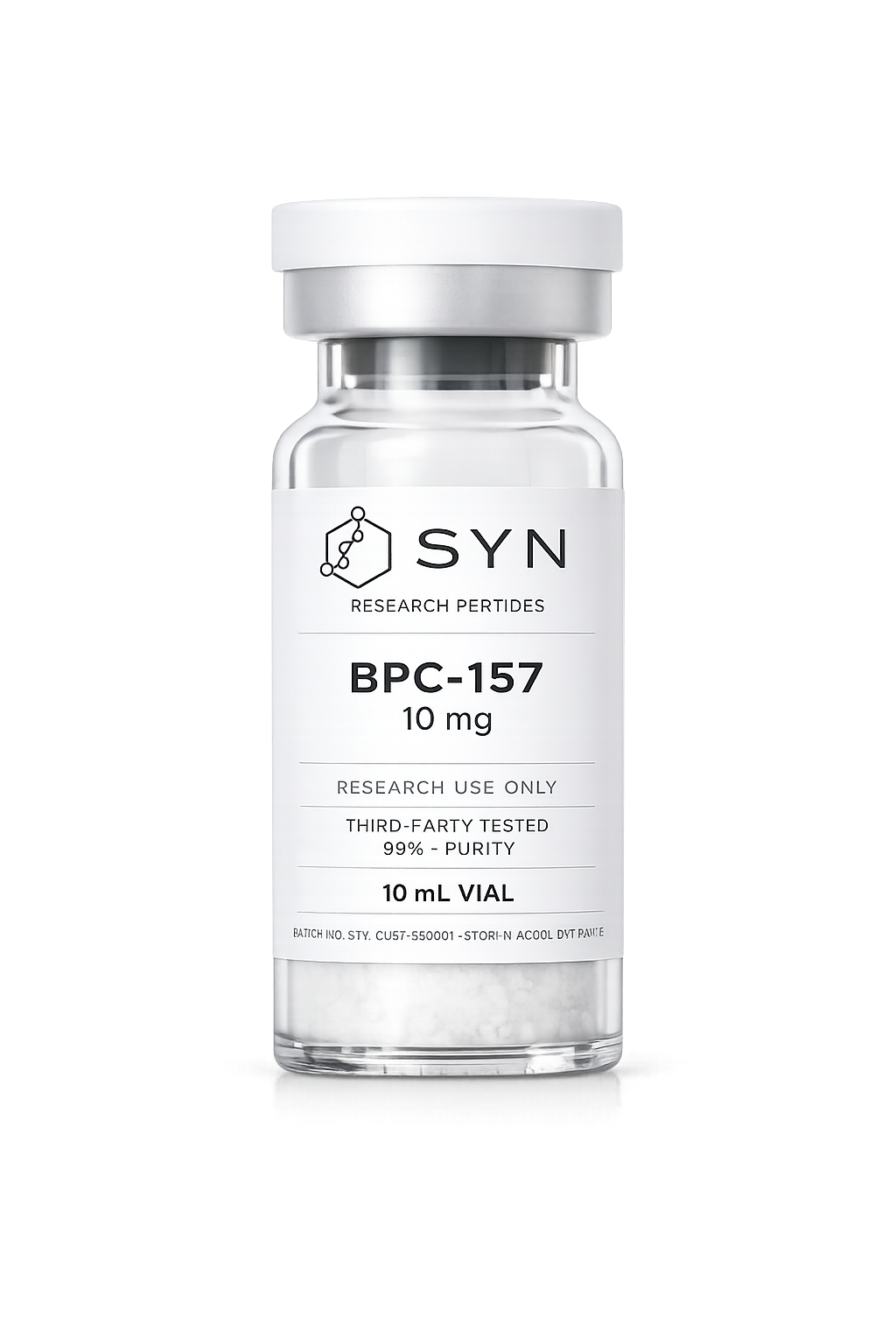
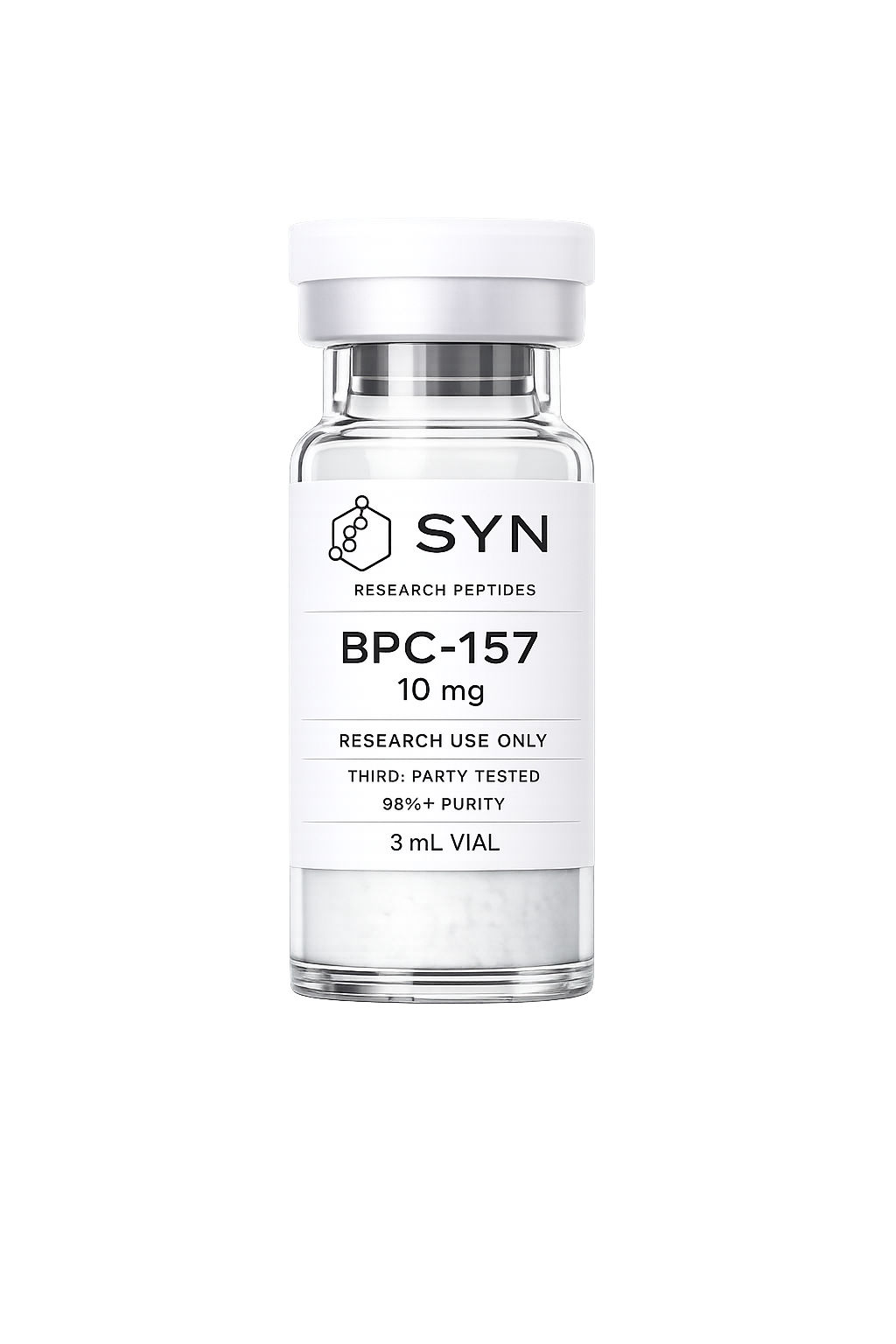
BPC-157 (Body Protection Compound-157) is a synthetic 15-amino acid peptide derived from human gastric juice. Supplied as a lyophilized powder in a 5mg, 3mL vial. Third-party tested at 99%+ purity. For research purposes only.
BPC-157 (Body Protection Compound-157) is a synthetic pentadecapeptide consisting of 15 amino acids, originally derived from a protein found in human gastric juice. It is one of the most extensively studied peptides in preclinical research, examined for its role in tissue repair signaling, angiogenesis, and growth factor receptor regulation.
For research use only. Not intended for human or animal consumption.
COA
Third-party Certificate of Analysis available upon request. All batches are independently tested via HPLC and mass spectrometry to verify ≥99% purity prior to release.
Contact support@synpeptidesciences.com to request batch-specific COA documentation.
Storage
All SYN Sciences peptides are manufactured using the lyophilization (freeze-drying) process, ensuring stability during shipping for up to 3–4 months at room temperature.
Once reconstituted with bacteriostatic water, store refrigerated at 2–8°C (36–46°F) and use within 30 days.
For long-term storage (months to years), store lyophilized peptide in a freezer at -20°C to -80°C, away from light and moisture.
Keep all peptides away from direct sunlight and repeated freeze-thaw cycles.
Manufacturing Process
All SYN Sciences peptides are synthesized using Solid Phase Peptide Synthesis (SPPS) — the industry gold standard for research-grade peptide production.
Process overview:
– Amino acid chains assembled on solid resin support under controlled conditions
– Cleavage and deprotection performed using pharmaceutical-grade reagents
– Purified via high-performance liquid chromatography (HPLC) to ≥99% purity
– Identity confirmed by mass spectrometry (MS)
– Screened for heavy metals and endotoxins
– Lyophilized (freeze-dried) and nitrogen-sealed in sterile vials for maximum stability
Every batch undergoes independent third-party quality verification before release.
Research & Sources
BPC-157 Research | SYN Research Peptides
Research Use Only — Not For Human Or Veterinary Consumption
Research Use Only Third-Party Tested 99%+ Purity Lyophilized
Scientific Documentation
Research & Literature
Peer-reviewed preclinical studies, mechanism of action, and laboratory specifications. Technical content includes plain-language clarifications for accessibility.
Compound Profile
BPC-157 is a synthetic pentadecapeptide — a chain of 15 amino acids derived from a partial sequence of the body protection compound (BPC) originally isolated from human gastric juice. First characterized by Sikiric and colleagues in the early 1990s, BPC-157 is one of the most extensively studied regenerative peptides in preclinical research.
The compound is notably stable in aqueous solutions — water-based environments and gastric juice. It demonstrates measurable activity in a wide range of in-vitro (test tube) and in-vivo (in living animals) studies. BPC-157 is currently not approved by the FDA for human therapeutic use; all research applications are restricted to laboratory and preclinical investigation.
Three small human pilot studies have been published as of 2025, examining intravenous safety, intra-articular knee injection, and interstitial cystitis. These pilot studies involved fewer than 30 total subjects across all trials and lacked placebo controls. Large-scale randomized human trials have not been completed.
In plain terms:
BPC-157 is a 15-amino-acid peptide that has been studied mostly in animals for over 30 years. Researchers have observed effects on tissue repair processes in animal models. Human research is very limited and the FDA has not approved it for any use.
Proposed Mechanisms of Action
The following pathways have been proposed in preclinical literature. Findings come primarily from animal and cell-culture studies; human translation has not been established.
01
Angiogenic Signaling
Upregulation of vascular endothelial growth factor (VEGF) and VEGFR2 expression, promoting endothelial cell migration and new vessel formation in tissue repair models.
Plain meaning: In animal studies, BPC-157 was associated with new blood vessel growth at injury sites — which delivers more nutrients to repairing tissue.
02
Nitric Oxide System Modulation
Interaction with the eNOS pathway via Src-Caveolin-1 phosphorylation, modulating vasomotor tone and microvascular response.
Plain meaning: The compound interacts with the body’s blood-vessel-tone control system, which regulates blood flow and inflammation response.
03
Growth Hormone Receptor Expression
Dose-dependent upregulation of growth hormone receptor mRNA and protein in tendon fibroblasts (in-vitro), enhancing fibroblast proliferation in animal models.
Plain meaning: In rat tendon cells, BPC-157 increased the number of receptors that respond to growth hormone — a possible mechanism for tendon healing observed in animals.
04
FAK-Paxillin Pathway
Modulation of focal adhesion kinase signaling, a pathway involved in cell migration and tissue remodeling.
Plain meaning: Influences a cellular signaling system that controls how cells move and rebuild damaged tissue.
05
Cytokine Modulation
In animal cancer-cachexia models, observed counteraction of pro-inflammatory cytokines including IL-6 and TNF-α.
Plain meaning: In animal studies, BPC-157 reduced certain inflammation-signaling proteins.
Important Research Context
A substantial portion of BPC-157 preclinical literature originates from a single research group. Independent replication remains limited. The mechanisms above describe pathways observed in animals and cells — they have not been confirmed to operate identically in humans. Researchers are encouraged to consult primary sources for a complete and balanced view.
Sources & References
Peer-reviewed preclinical and pilot research
HSS Journal · 2025
Emerging Use of BPC-157 in Orthopaedic Sports Medicine: A Systematic Review
Soluble in bacteriostatic water, sterile water, PBS
Storage (Lyophilized)
−20°C, protected from light, sealed vial
Storage (Reconstituted)
2–8°C; use within recommended laboratory protocol
Stability
Stable in aqueous solution and gastric juice (in-vitro)
Half-Life (animal models)
< 30 minutes (per Vasireddi et al., 2025)
Intended Use
In-vitro laboratory research and scientific study only
Regulatory Status
Not FDA approved for human or veterinary use
Certificate of Analysis
Each batch of BPC-157 supplied by SYN Research Peptides is third-party tested for identity and purity by an independent analytical laboratory. The Certificate of Analysis (COA) details HPLC purity verification, mass spectrometry confirmation, and batch-specific quality data.