
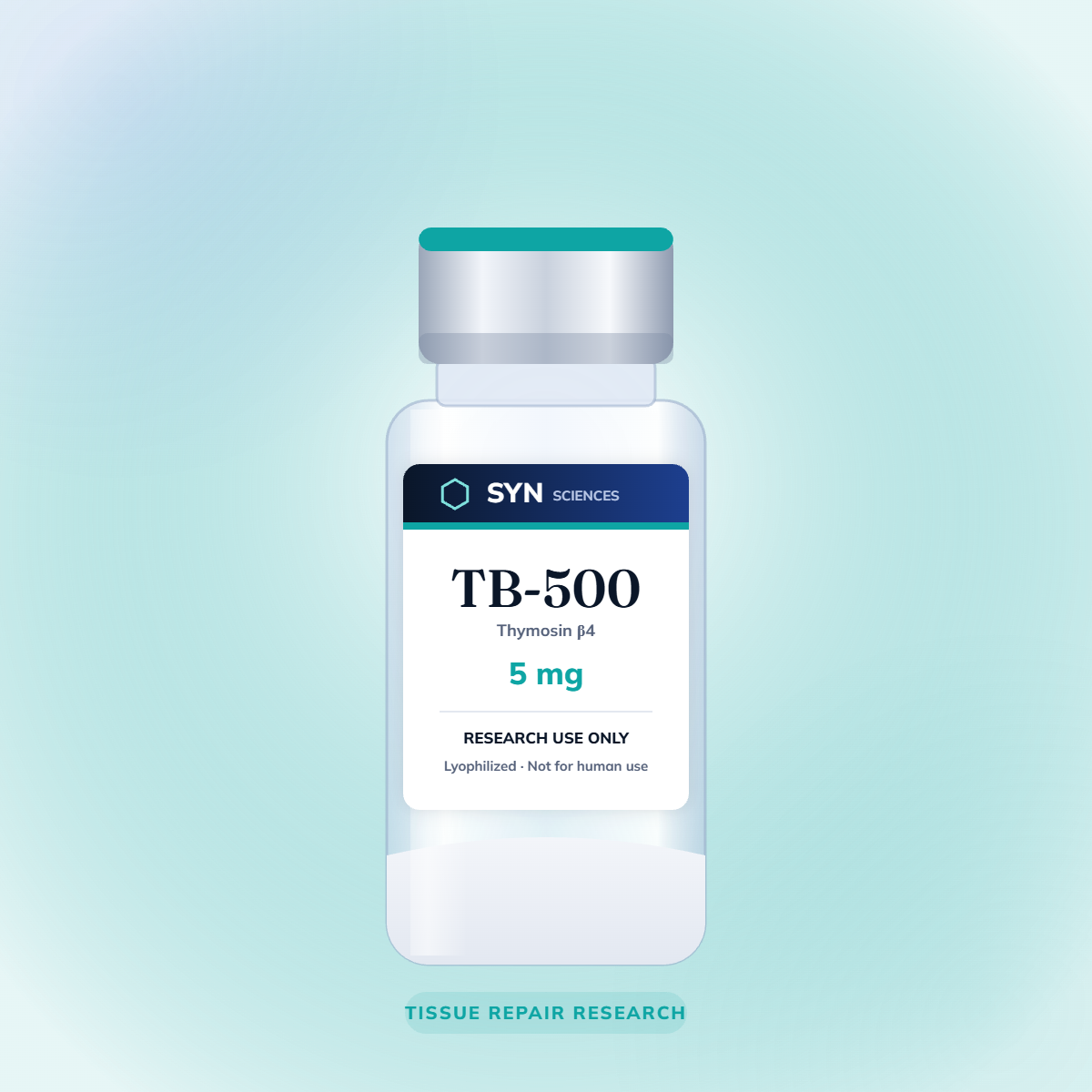
TB-500
Research & Literature
Peer-reviewed preclinical studies, mechanism of action, and laboratory specifications. Technical content includes plain-language clarifications for accessibility.
Compound Profile
TB-500 from SYN Sciences is supplied as synthetic thymosin beta-4 (Tβ4), a 43-amino-acid peptide (a short chain of amino acids). Tβ4 is one of the most abundant peptides inside mammalian cells and is the principal G-actin–sequestering molecule (it binds single actin units and helps control how the cell’s internal scaffolding is built and taken apart).
Research interest in Tβ4 comes from preclinical observations of its involvement in cell migration, new blood vessel formation, and tissue-repair processes in in-vitro (cell culture) and in-vivo (in living animals) models, including dermal, corneal, and cardiac injury models in rodents. Small human clinical studies have tested specific formulated Tβ4 products, but Tβ4 is not approved by the FDA for any human or veterinary use.
A note on naming: In the analytical literature, “TB-500” has also been used for a much shorter fragment — the acetylated 17–23 sequence Ac-LKKTETQ (Esposito et al., 2012). An independent 2023 analysis found that products sold online as TB-500 do not consistently match their stated contents. Our TB-500 is specified as full-length Tβ4 (~4963 Da), and identity is confirmed by mass spectrometry on each batch’s Certificate of Analysis.
Proposed Mechanisms of Action
The following pathways have been described in peer-reviewed preclinical literature. Each entry includes a plain-language explanation.
- 01Actin Sequestration Tβ4 binds monomeric G-actin through its central actin-binding motif (LKKTETQ, residues 17–23), regulating actin polymerization and cytoskeletal remodeling in cell models.Plain meaning: It controls the supply of building blocks that cells use to change shape and move.
- 02ILK–Akt Survival Signaling In mouse cardiac injury models, Tβ4 formed a complex with PINCH and integrin-linked kinase (ILK), activating Akt signaling and promoting cardiomyocyte migration and survival (Bock-Marquette et al., 2004).Plain meaning: In mice, it switched on a signaling pathway linked to heart-cell movement and survival after injury.
- 03Angiogenesis and Epicardial Progenitors In adult mice, Tβ4 stimulated mobilization of epicardial progenitor cells and neovascularization (Smart et al., 2007).Plain meaning: In mouse hearts, it was associated with activating repair-related cells and new blood vessel growth.
- 04Matrix Metalloproteinase Expression Tβ4 increased expression of matrix metalloproteinases, enzymes that remodel the extracellular matrix during cell migration, in wound-repair models (Philp et al., 2006).Plain meaning: It raised levels of enzymes that clear a path through surrounding tissue so cells can migrate.
- 05Distinct Active Sites Different regions of the 43-aa sequence appear to drive different effects: the N-terminal tetrapeptide Ac-SDKP is associated with anti-inflammatory and anti-fibrotic activity, while the LKKTETQ region is associated with angiogenesis and wound repair in preclinical models (Sosne et al., 2010).Plain meaning: Separate pieces of the peptide seem to be responsible for separate effects seen in the lab.
Most Tβ4 mechanism data come from cell-culture and rodent studies. A 2024 study suggested that some wound-healing activity attributed to the short TB-500 fragment may come from its metabolite Ac-LKKTE rather than the parent peptide (Rahaman et al., 2024). Mechanisms observed in animals and cells have not been confirmed to operate the same way in humans.
Sources & References
Peer-reviewed preclinical and pilot research
Thymosin beta4: actin-sequestering protein moonlights to repair injured tissues
View SourceThymosin β4: a multi-functional regenerative peptide. Basic properties and clinical applications
View SourceThymosin beta 4: A novel corneal wound healing and anti-inflammatory agent
View SourceBiological activities of thymosin beta4 defined by active sites in short peptide sequences
View SourceThymosin beta4 accelerates wound healing
View SourceThymosin beta4 activates integrin-linked kinase and promotes cardiac cell migration, survival and cardiac repair
View SourceThymosin beta4 induces adult epicardial progenitor mobilization and neovascularization
View SourceThymosin beta4 promotes matrix metalloproteinase expression during wound repair
View SourceThymosin beta-4 and venous ulcers: clinical remarks on a European prospective, randomized study on safety, tolerability, and enhancement on healing
View SourceThymosin beta 4 ophthalmic solution for dry eye: a randomized, placebo-controlled, Phase II clinical trial conducted using the controlled adverse environment (CAE™) model
View SourceSynthesis and characterization of the N-terminal acetylated 17-23 fragment of thymosin beta 4 identified in TB-500, a product suspected to possess doping potential
View SourceDoping control analysis of TB-500, a synthetic version of an active region of thymosin β₄, in equine urine and plasma by liquid chromatography-mass spectrometry
View SourceTB500/TB1000 and SGF1000: A scientific approach for a better understanding of misbranded and adulterated drugs
View SourceSimultaneous quantification of TB-500 and its metabolites in in-vitro experiments and rats by UHPLC-Q-Exactive orbitrap MS/MS and their screening by wound healing activities in-vitro
View Source| Compound Name | TB-500 (supplied as Thymosin Beta-4, Tβ4) |
|---|---|
| Chemical Class | Synthetic peptide, 43 amino acids, N-terminally acetylated |
| Amino Acid Sequence | Ac-SDKPDMAEIEKFDKSKLKKTETQEKNPLPSKETIEQEKQAGES |
| Molecular Formula | C₂₁₂H₃₅₀N₅₆O₇₈S |
| Molecular Weight | 4963.5 g/mol |
| CAS Number | 77591-33-4 |
| Purity | ≥ 99% by HPLC |
| Identity | Confirmed by mass spectrometry (see batch COA) |
| Form | Lyophilized white to off-white powder |
| Vial Contents | 5 mg net peptide content per vial |
| Solubility | Sterile water, PBS |
| Storage (Lyophilized) | −20°C, protected from light and moisture |
| Storage (In Solution) | 2–8°C, per laboratory protocol |
| Intended Use | In-vitro laboratory research and scientific study only |
| Regulatory Status | Not FDA approved for human or veterinary use |
Certificate of Analysis
SYN Sciences uses independent third-party analytical testing (Janoshik Analytical) to verify the identity and purity of TB-500. Certificates of Analysis report HPLC purity and mass spectrometry identity results and are posted to the COA Library as they become available for each batch.
Batch Number: Listed on vial label and batch COA
View COA LibraryNeed the COA for your specific batch? Email support@synpeptidesciences.com with your order number and we will send the analytical report.