
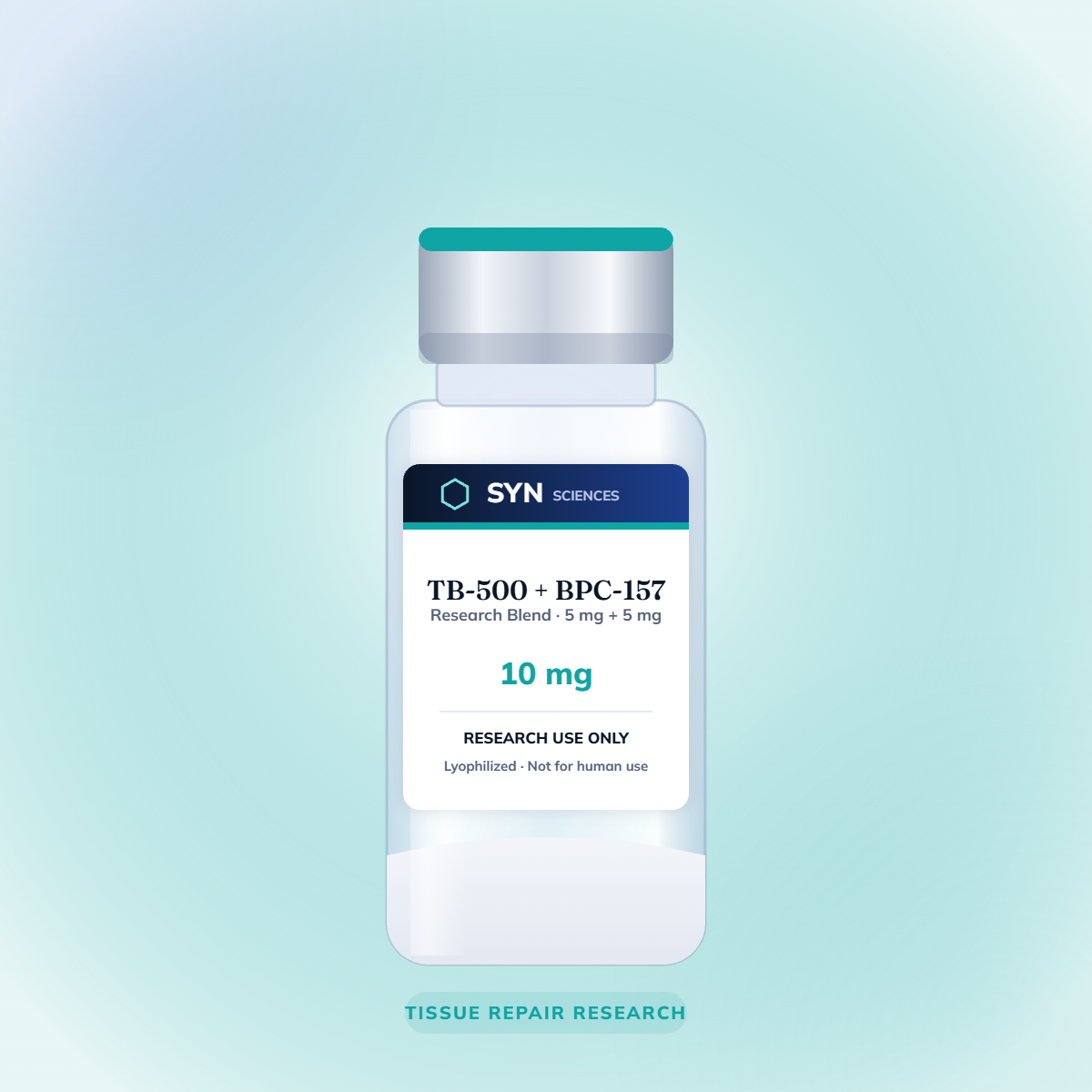
TB-500 + BPC-157 Blend
Research & Literature
Peer-reviewed preclinical studies, mechanism of action, and laboratory specifications. Technical content includes plain-language clarifications for accessibility.
Blend Profile
This research blend combines two peptides in one vial: TB-500, supplied as synthetic thymosin beta-4 (a 43-amino-acid actin-binding peptide), and BPC-157, a synthetic 15-amino-acid peptide derived from a sequence originally isolated from gastric juice. Each has its own body of preclinical literature describing different pathways: thymosin β4 is primarily studied for actin regulation and cell migration, while BPC-157 is primarily studied for angiogenic (blood-vessel-forming) signaling.
Research on the two peptides together is very limited. In a 2026 rat Achilles tendon model, both peptides were associated with improved tissue-structure scores, but the combination did not show additional benefit over either peptide alone (Biçer et al., 2026). Neither peptide is approved by the FDA for any human or veterinary use.
Proposed Mechanisms of Action
The pathways below were described for each component individually in peer-reviewed preclinical literature. They have not been established for the combination.
- 01BPC-157 · VEGFR2–Akt–eNOS Signaling In endothelial cell and rat hind-limb ischemia models, BPC-157 was associated with VEGFR2 activation and up-regulation and downstream Akt–eNOS signaling (Hsieh et al., 2017).Plain meaning: In animal and cell studies, BPC-157 switched on a receptor linked to new blood vessel growth.
- 02BPC-157 · FAK–Paxillin and Cell Migration In tendon fibroblast cultures, BPC-157 promoted cell outgrowth, survival, and migration, associated with activation of the FAK–paxillin pathway (Chang et al., 2011).Plain meaning: In lab-grown tendon cells, BPC-157 helped cells survive and move.
- 03BPC-157 · Growth Hormone Receptor Expression BPC-157 increased growth hormone receptor expression in rat tendon fibroblasts in vitro (Chang et al., 2014).Plain meaning: In rat tendon cells, it increased the number of receptors that respond to growth hormone.
- 04TB-500 · Actin Sequestration Thymosin β4 binds monomeric G-actin via its LKKTETQ motif (residues 17–23), regulating actin polymerization and cytoskeletal remodeling (Goldstein et al., 2005).Plain meaning: It controls the supply of building blocks cells use to change shape and move.
- 05TB-500 · ILK–Akt Signaling In mouse cardiac injury models, thymosin β4 activated integrin-linked kinase and Akt signaling and promoted cardiomyocyte migration and survival (Bock-Marquette et al., 2004).Plain meaning: In mice, it switched on a pathway linked to heart-cell movement and survival after injury.
No mechanism of interaction between BPC-157 and thymosin β4 has been established. The only identified study of the combination (rat Achilles tendon, 2026) reported no added benefit from combining them. Much of the BPC-157 literature comes from a single research group, and all mechanisms above come from cell and animal models that have not been confirmed in humans.
Sources & References
Peer-reviewed preclinical and pilot research
Effects of BPC-157 and TB-500 on Achilles tendon healing in rats: A histopathological and biomechanical study
View SourceSafety and Efficacy of Approved and Unapproved Peptide Therapies for Musculoskeletal Injuries and Athletic Performance
View SourceEmerging Use of BPC-157 in Orthopaedic Sports Medicine: A Systematic Review
View SourceRegeneration or Risk? A Narrative Review of BPC-157 for Musculoskeletal Healing
View SourceThymosin beta4: actin-sequestering protein moonlights to repair injured tissues
View SourceTherapeutic potential of pro-angiogenic BPC157 is associated with VEGFR2 activation and up-regulation
View SourceThe promoting effect of pentadecapeptide BPC 157 on tendon healing involves tendon outgrowth, cell survival, and cell migration
View SourcePentadecapeptide BPC 157 enhances the growth hormone receptor expression in tendon fibroblasts
View SourceGastric pentadecapeptide BPC 157 accelerates healing of transected rat Achilles tendon and in vitro stimulates tendocytes growth
View SourceThymosin beta4 activates integrin-linked kinase and promotes cardiac cell migration, survival and cardiac repair
View SourceThymosin beta4 accelerates wound healing
View SourceSynthesis and characterization of the N-terminal acetylated 17-23 fragment of thymosin beta 4 identified in TB-500, a product suspected to possess doping potential
View SourceTB500/TB1000 and SGF1000: A scientific approach for a better understanding of misbranded and adulterated drugs
View Source| Product Name | TB-500 + BPC-157 Research Blend |
|---|---|
| Composition | TB-500 (thymosin β4) 5 mg + BPC-157 5 mg |
| Total Peptide Content | 10 mg per vial |
| TB-500 Sequence | Ac-SDKPDMAEIEKFDKSKLKKTETQEKNPLPSKETIEQEKQAGES |
| TB-500 Formula / MW | C₂₁₂H₃₅₀N₅₆O₇₈S · 4963.5 g/mol |
| BPC-157 Sequence | Gly-Glu-Pro-Pro-Pro-Gly-Lys-Pro-Ala-Asp-Asp-Ala-Gly-Leu-Val |
| BPC-157 Formula / MW | C₆₂H₉₈N₁₆O₂₂ · 1419.5 g/mol |
| Purity | ≥ 99% per component by HPLC |
| Identity | Confirmed by mass spectrometry (see batch COA) |
| Form | Co-lyophilized white to off-white powder |
| Solubility | Sterile water, PBS |
| Storage (Lyophilized) | −20°C, protected from light and moisture |
| Storage (In Solution) | 2–8°C, per laboratory protocol |
| Intended Use | In-vitro laboratory research and scientific study only |
| Regulatory Status | Not FDA approved for human or veterinary use |
Certificate of Analysis
SYN Sciences uses independent third-party analytical testing (Janoshik Analytical) to verify the identity and purity of TB-500 + BPC-157 Blend. Certificates of Analysis report HPLC purity and mass spectrometry identity results and are posted to the COA Library as they become available for each batch.
Batch Number: Listed on vial label and batch COA
View COA LibraryNeed the COA for your specific batch? Email support@synpeptidesciences.com with your order number and we will send the analytical report.