
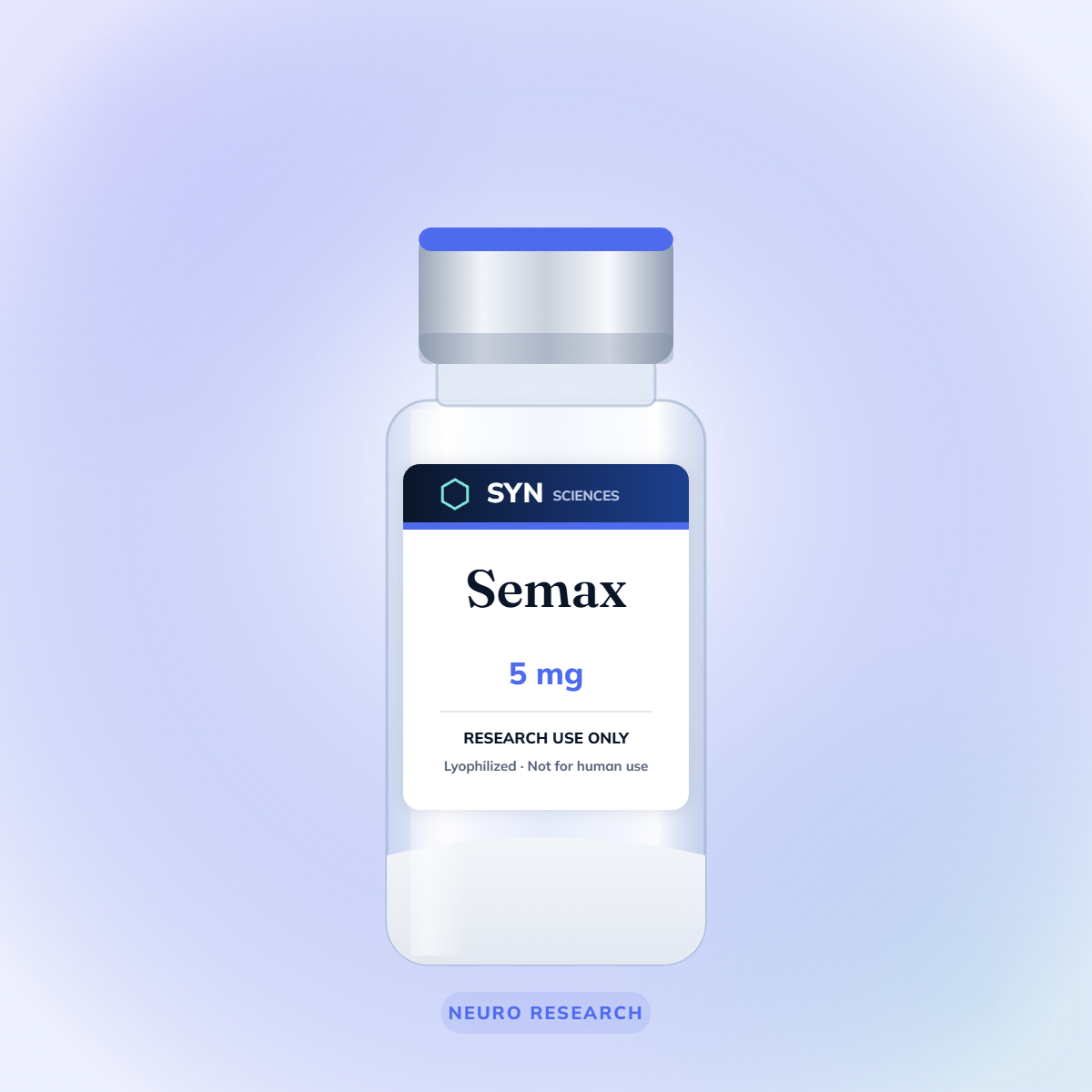
Semax
Research & Literature
Peer-reviewed preclinical studies, mechanism of action, and laboratory specifications. Technical content includes plain-language clarifications for accessibility.
Compound Profile
Semax is a synthetic heptapeptide (a chain of seven amino acids) made of the ACTH(4-7) fragment (a short piece of the pituitary hormone adrenocorticotropin) joined to a C-terminal Pro-Gly-Pro tripeptide that slows enzymatic breakdown. It was developed in Russia and lacks the hormonal (adrenal-stimulating) activity of full-length ACTH.
Preclinical research has focused on the nervous system: in in-vivo (animal) models, Semax has been studied for effects on neurotrophin expression, gene-expression responses after cerebral ischemia, and recovery after spinal cord injury. Semax is registered as a medicine in Russia, but it is not approved by the FDA for any human or veterinary use in the United States.
Proposed Mechanisms of Action
The following pathways have been described in peer-reviewed preclinical literature. Each entry includes a plain-language explanation.
- 01BDNF / TrkB Regulation In the rat hippocampus, Semax increased BDNF protein and mRNA levels and TrkB receptor phosphorylation, accompanied by changes in a conditioned-avoidance learning task (Dolotov et al., 2006).Plain meaning: In rats, it raised levels of a key brain growth factor and activated that factor’s receptor.
- 02Neurotrophin Gene Transcription After Ischemia After experimental cerebral ischemia in rats, Semax and its Pro-Gly-Pro fragment activated transcription of neurotrophins and their receptor genes (Dmitrieva et al., 2010).Plain meaning: After a stroke-like injury in rats, it switched on genes for brain-protective growth factors.
- 03Immune and Vascular Gene Expression Genome-wide analysis in a rat focal ischemia model showed Semax altered expression of genes related to immune response and the vascular system (Medvedeva et al., 2014).Plain meaning: It changed activity of genes involved in inflammation and blood vessels after injury in rats.
- 04Opioid-Receptor–Linked Recovery Pathways In female mice with spinal cord injury, Semax was reported to act through the μ-opioid receptor gene Oprm1, promoting deubiquitination and functional recovery (Liu et al., 2025).Plain meaning: In mice with spinal injuries, it was linked to a pathway that helped nerve function recover.
- 05Metal-Ion Interactions Semax binds copper(II) ions and affected copper-induced amyloid-β aggregation in vitro (Sciacca et al., 2022).Plain meaning: In test-tube experiments, it bound copper and changed how a protein linked to Alzheimer’s disease clumps together.
Most Semax research comes from a small number of research groups, primarily in Russia, and much of the clinical literature is published in Russian-language journals. Mechanisms observed in rodents and in vitro have not been confirmed to operate the same way in humans.
Sources & References
Peer-reviewed preclinical and pilot research
Semax, an analog of ACTH(4-10) with cognitive effects, regulates BDNF and trkB expression in the rat hippocampus
View SourceSemax and Pro-Gly-Pro activate the transcription of neurotrophins and their receptor genes after cerebral ischemia
View SourceThe peptide semax affects the expression of genes related to the immune and vascular systems in rat brain focal ischemia: genome-wide transcriptional analysis
View SourceSemax peptide targets the μ opioid receptor gene Oprm1 to promote deubiquitination and functional recovery after spinal cord injury in female mice
View SourceAntidepressant-like and antistress effects of the ACTH(4-10) synthetic analogs Semax and Melanotan II on male rats in a model of chronic unpredictable stress
View SourceSemax, a Synthetic Regulatory Peptide, Affects Copper-Induced Abeta Aggregation and Amyloid Formation in Artificial Membrane Models
View SourceInfluence of the N-terminus acetylation of Semax, a synthetic analog of ACTH(4-10), on copper(II) and zinc(II) coordination and biological properties
View Source| Compound Name | Semax (ACTH 4-7 Pro-Gly-Pro) |
|---|---|
| Chemical Class | Synthetic heptapeptide |
| Amino Acid Sequence | Met-Glu-His-Phe-Pro-Gly-Pro |
| Molecular Formula | C₃₇H₅₁N₉O₁₀S |
| Molecular Weight | 813.93 g/mol |
| CAS Number | 80714-61-0 |
| Purity | ≥ 99% by HPLC |
| Identity | Confirmed by mass spectrometry (see batch COA) |
| Form | Lyophilized white to off-white powder |
| Vial Contents | 5 mg net peptide content per vial |
| Solubility | Sterile water, PBS |
| Storage (Lyophilized) | −20°C, protected from light and moisture |
| Storage (In Solution) | 2–8°C, per laboratory protocol |
| Intended Use | In-vitro laboratory research and scientific study only |
| Regulatory Status | Not FDA approved for human or veterinary use |
Certificate of Analysis
SYN Sciences uses independent third-party analytical testing (Janoshik Analytical) to verify the identity and purity of Semax. Certificates of Analysis report HPLC purity and mass spectrometry identity results and are posted to the COA Library as they become available for each batch.
Batch Number: Listed on vial label and batch COA
View COA LibraryNeed the COA for your specific batch? Email support@synpeptidesciences.com with your order number and we will send the analytical report.