
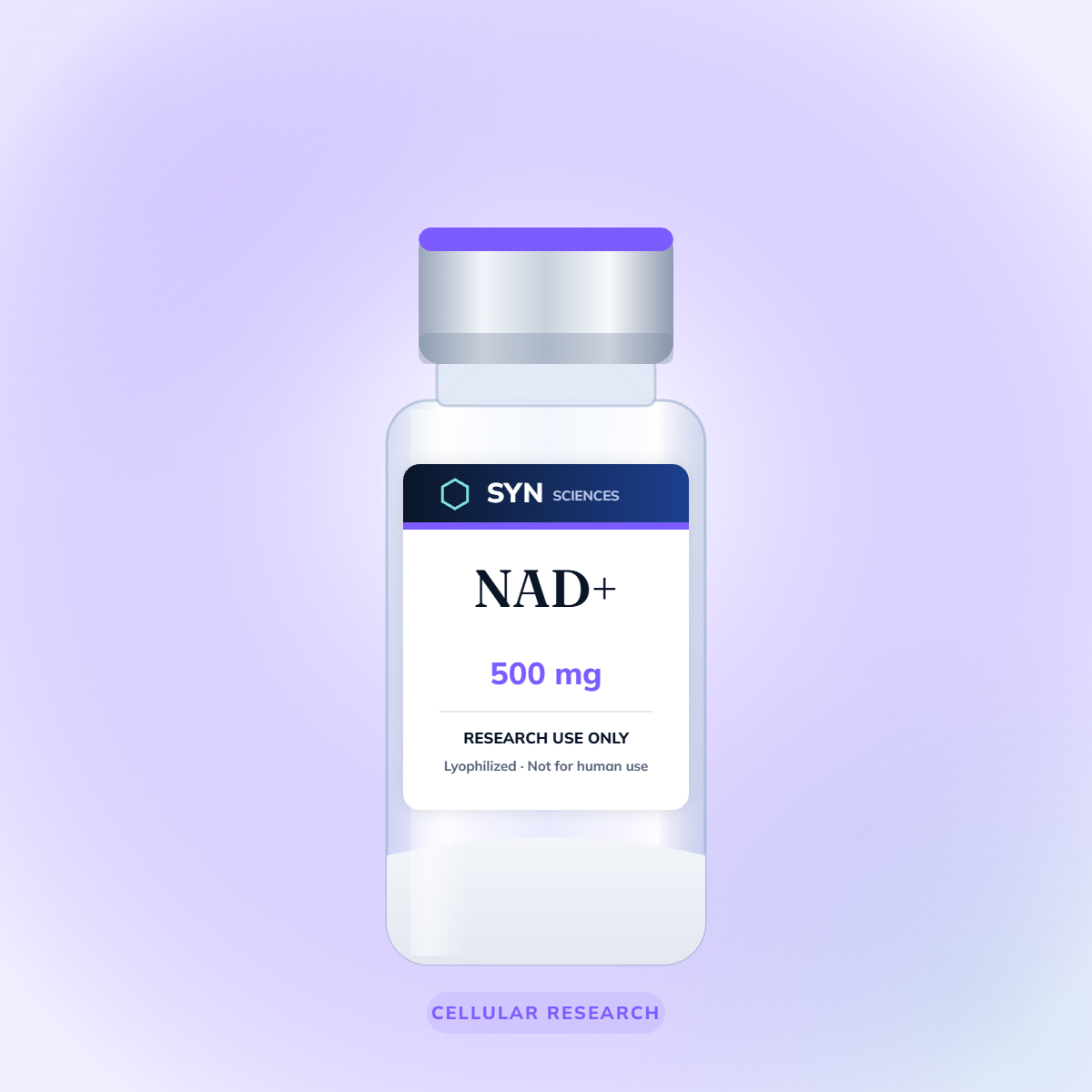
NAD+
Research & Literature
Peer-reviewed preclinical studies, mechanism of action, and laboratory specifications. Technical content includes plain-language clarifications for accessibility.
Compound Profile
Nicotinamide adenine dinucleotide (NAD+) is a coenzyme found in every living cell. It is not a peptide; it is a dinucleotide (two nucleotides joined through their phosphate groups) that shuttles electrons in metabolic reactions and serves as a substrate for several enzyme families, including sirtuins, PARPs, and CD38 (enzymes that consume NAD+ to regulate cell signaling, DNA repair, and other processes).
A large body of research in in-vitro (cell culture) and in-vivo (animal) models has examined how tissue NAD+ levels change with age and how those changes relate to mitochondrial function. Small human studies have measured how NAD+ and its metabolites behave in blood and urine. NAD+ in this form is not approved by the FDA as a drug for any human or veterinary use.
Proposed Mechanisms of Action
NAD+ participates in several well-characterized biochemical pathways. Each entry includes a plain-language explanation.
- 01Redox Cofactor NAD+ accepts electrons to form NADH in glycolysis, the TCA cycle, and fatty-acid oxidation, and NADH donates them to the mitochondrial electron transport chain (Covarrubias et al., 2021).Plain meaning: It works like a rechargeable battery that carries energy between steps of metabolism.
- 02Sirtuin Substrate Sirtuins (SIRT1–7) are NAD+-dependent deacylases that regulate metabolism, stress responses, and mitochondrial function; their activity depends on NAD+ availability (Imai and Guarente, 2014).Plain meaning: A family of regulatory enzymes can only work when NAD+ is available.
- 03PARP and DNA Repair Poly(ADP-ribose) polymerases consume NAD+ when signaling DNA damage, linking NAD+ levels to genome maintenance (Verdin, 2015).Plain meaning: DNA-repair enzymes use up NAD+ when they respond to damage.
- 04CD38-Mediated Consumption In mice, the NADase CD38 was identified as a major driver of age-related tissue NAD+ decline and associated mitochondrial dysfunction (Camacho-Pereira et al., 2016); senescent cells were shown to promote CD38+ macrophage activity (Covarrubias et al., 2020).Plain meaning: In aging mice, one enzyme appears to be a main reason NAD+ levels fall.
- 05Nuclear–Mitochondrial Communication In aging mice, declining NAD+ was associated with a pseudohypoxic state that disrupted communication between the nucleus and mitochondria (Gomes et al., 2013).Plain meaning: In mice, low NAD+ disrupted signaling between the cell’s control center and its power plants.
Most evidence linking NAD+ levels to aging comes from rodent models, and much of the in-vivo literature studies NAD+ precursors (such as NMN and NR) rather than NAD+ itself (Rajman et al., 2018). Human data on NAD+ are limited to small pilot and metabolomic studies.
Sources & References
Peer-reviewed preclinical and pilot research
NAD(+) metabolism and its roles in cellular processes during ageing
View SourceNAD⁺ in aging, metabolism, and neurodegeneration
View SourceNAD+ and sirtuins in aging and disease
View SourceTherapeutic Potential of NAD-Boosting Molecules: The In Vivo Evidence
View SourceDeclining NAD(+) induces a pseudohypoxic state disrupting nuclear-mitochondrial communication during aging
View SourceCD38 Dictates Age-Related NAD Decline and Mitochondrial Dysfunction through an SIRT3-Dependent Mechanism
View SourceSenescent cells promote tissue NAD(+) decline during ageing via the activation of CD38(+) macrophages
View SourceA Pilot Study Investigating Changes in the Human Plasma and Urine NAD+ Metabolome During a 6 Hour Intravenous Infusion of NAD
View Source| Compound Name | NAD+ (β-Nicotinamide adenine dinucleotide, oxidized) |
|---|---|
| Chemical Class | Dinucleotide coenzyme |
| Molecular Formula | C₂₁H₂₇N₇O₁₄P₂ |
| Molecular Weight | 663.43 g/mol |
| CAS Number | 53-84-9 |
| Purity | ≥ 99% by HPLC |
| Identity | Confirmed by analytical testing (see COA) |
| Form | Lyophilized white to off-white powder |
| Vial Contents | 500 mg per vial |
| Solubility | Water, PBS |
| Storage (Lyophilized) | −20°C, desiccated, protected from light |
| Storage (In Solution) | 2–8°C; NAD+ degrades in solution, prepare fresh per protocol |
| Intended Use | In-vitro laboratory research and scientific study only |
| Regulatory Status | Not FDA approved as a drug for human or veterinary use |
Certificate of Analysis
SYN Sciences uses independent third-party analytical testing (Janoshik Analytical) to verify the identity and purity of NAD+. Certificates of Analysis report HPLC purity and mass spectrometry identity results and are posted to the COA Library as they become available for each batch.
Batch Number: Listed on vial label and batch COA
View COA LibraryNeed the COA for your specific batch? Email support@synpeptidesciences.com with your order number and we will send the analytical report.