
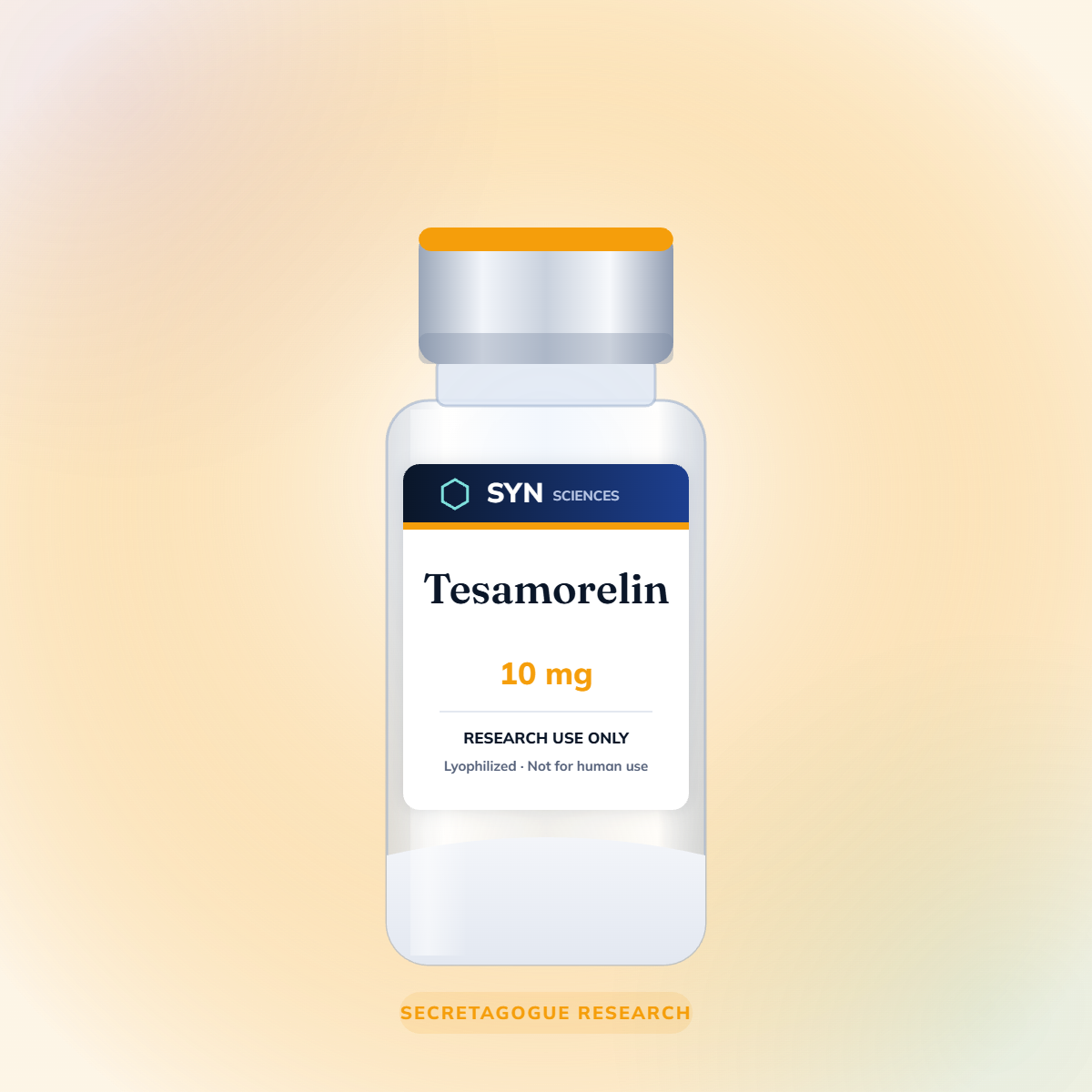
Tesamorelin
Research & Literature
Peer-reviewed preclinical studies, mechanism of action, and laboratory specifications. Technical content includes plain-language clarifications for accessibility.
Compound Profile
Tesamorelin is a synthetic analog of the full 44-amino-acid human growth hormone–releasing factor (hGRF 1-44), modified with a trans-3-hexenoyl group at its N-terminus (a small chemical cap intended to slow enzymatic breakdown). Like native GHRH, it acts on the GHRH receptor of the anterior pituitary.
Tesamorelin is the active ingredient of an FDA-approved prescription drug. The material sold here is not that drug. It is a research-grade reference compound that is not manufactured, labeled, or tested to pharmaceutical standards and is supplied only for in-vitro laboratory research. It is not for human or veterinary use.
Proposed Mechanisms of Action
The pharmacology below is summarized from peer-reviewed reviews and published studies. Each entry includes a plain-language explanation.
- 01GHRH Receptor Agonism Tesamorelin binds the GHRH receptor on pituitary somatotrophs, stimulating synthesis and pulsatile release of endogenous growth hormone (Wang and Tomlinson, 2009).Plain meaning: It activates the pituitary receptor for the natural growth-hormone-releasing signal.
- 02N-Terminal Stabilization The trans-3-hexenoyl modification was designed to protect the N-terminus from dipeptidyl peptidase-4 cleavage, which rapidly inactivates native GHRH (Wang and Tomlinson, 2009).Plain meaning: A chemical cap on one end makes the peptide harder for enzymes to break down.
- 03Downstream IGF-1 Signaling Growth hormone released in response to tesamorelin stimulates hepatic production of insulin-like growth factor 1 (IGF-1), the principal mediator of many GH effects (Grunfeld, 2011).Plain meaning: The growth hormone it releases tells the liver to make a second signaling molecule, IGF-1.
- 04Preserved Feedback Regulation Because tesamorelin acts upstream of growth hormone, GH release remains subject to physiological feedback such as somatostatin inhibition (Spooner and Olin, 2012).Plain meaning: The body’s normal brakes on growth hormone release still work.
Published tesamorelin literature consists mainly of clinical pharmacology and clinical trials of the approved drug product. Those results describe a pharmaceutical-grade product under medical supervision and do not apply to research-grade material. This page is provided for scientific reference only.
Sources & References
Peer-reviewed preclinical and pilot research
Tesamorelin
View SourceTesamorelin, a human growth hormone releasing factor analogue
View SourceTesamorelin: a growth hormone-releasing factor analogue for HIV-associated lipodystrophy
View SourceMetabolic effects of a growth hormone-releasing factor in patients with HIV
View SourceSafety and metabolic effects of tesamorelin, a growth hormone-releasing factor analogue, in patients with type 2 diabetes: A randomized, placebo-controlled trial
View Source| Compound Name | Tesamorelin (research grade) |
|---|---|
| Chemical Class | Synthetic GHRH(1-44) analog, 44 amino acids |
| N-Terminal Modification | trans-3-hexenoyl |
| Molecular Formula | C₂₂₁H₃₆₆N₇₂O₆₇S |
| Molecular Weight | 5135.9 g/mol |
| CAS Number | 218949-48-5 |
| Purity | ≥ 99% by HPLC |
| Identity | Confirmed by mass spectrometry (see batch COA) |
| Form | Lyophilized white to off-white powder |
| Vial Contents | 10 mg net peptide content per vial |
| Solubility | Sterile water, PBS |
| Storage (Lyophilized) | −20°C, protected from light and moisture |
| Storage (In Solution) | 2–8°C, per laboratory protocol |
| Intended Use | In-vitro laboratory research and scientific study only |
| Regulatory Status | Research-grade material; not an FDA-approved drug product; not for human or veterinary use |
Certificate of Analysis
SYN Sciences uses independent third-party analytical testing (Janoshik Analytical) to verify the identity and purity of Tesamorelin. Certificates of Analysis report HPLC purity and mass spectrometry identity results and are posted to the COA Library as they become available for each batch.
Batch Number: Listed on vial label and batch COA
View COA LibraryNeed the COA for your specific batch? Email support@synpeptidesciences.com with your order number and we will send the analytical report.