
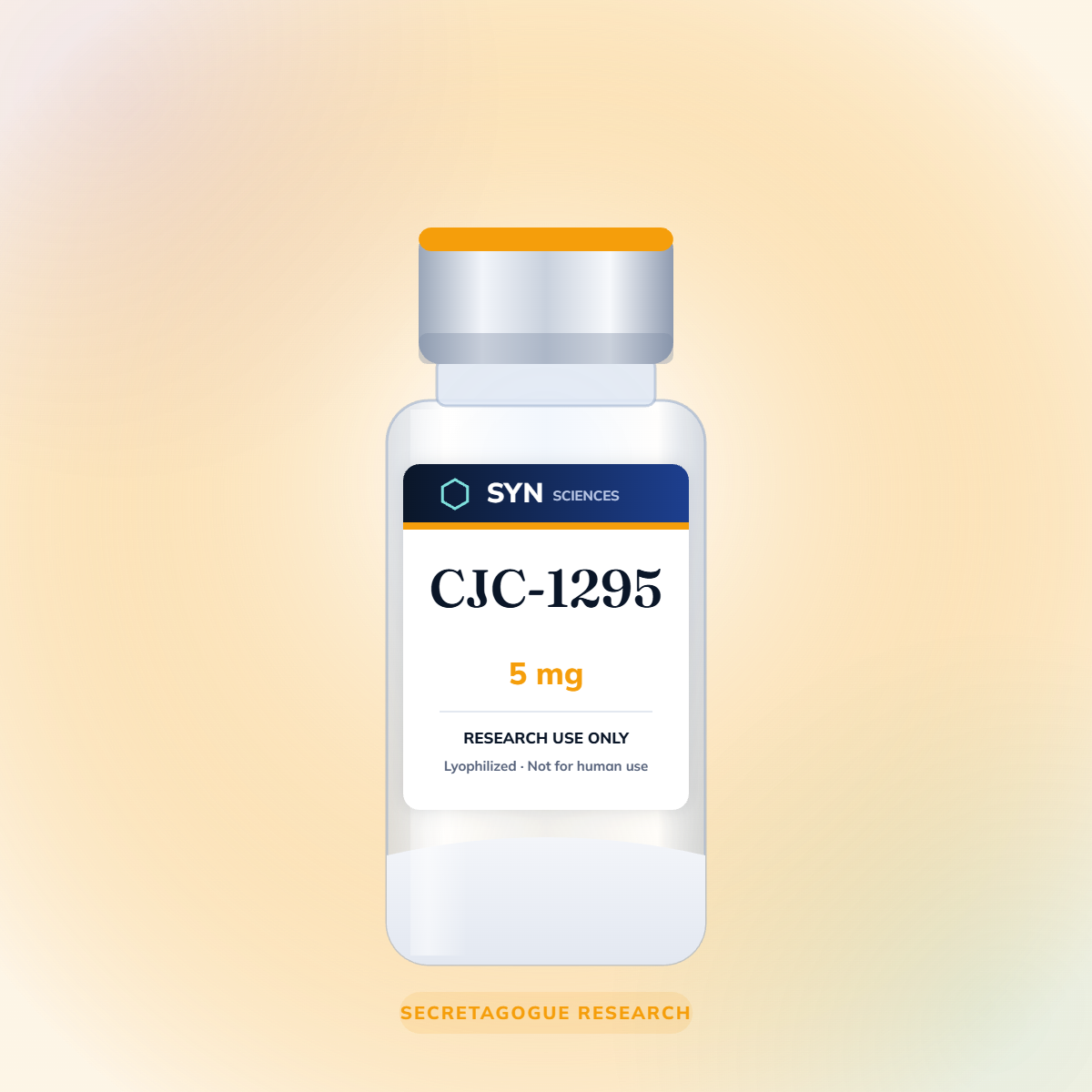
CJC-1295
Research & Literature
Peer-reviewed preclinical studies, mechanism of action, and laboratory specifications. Technical content includes plain-language clarifications for accessibility.
Compound Profile
CJC-1295 belongs to a family of synthetic analogs of growth hormone–releasing hormone (GHRH) based on its biologically active first 29 amino acids, GHRH(1-29). This product is the form without DAC, also called Modified GRF (1-29): a 29-amino-acid peptide with four amino-acid substitutions (D-Ala², Gln⁸, Ala¹⁵, Leu²⁷, intended to resist enzymatic breakdown).
Much of the published CJC-1295 literature studied a different form with DAC (Drug Affinity Complex), which adds a reactive linker that binds serum albumin (the most abundant blood protein) to extend half-life (Jetté et al., 2005). Findings for the DAC form should not be assumed to apply to the non-DAC peptide. CJC-1295 is not approved by the FDA for any human or veterinary use and is prohibited in competitive sport.
Proposed Mechanisms of Action
The following pathways have been described in peer-reviewed literature on GHRH analogs, including CJC-1295. Each entry includes a plain-language explanation.
- 01GHRH Receptor Agonism GHRH(1-29) analogs bind the GHRH receptor on pituitary somatotroph cells, stimulating growth hormone synthesis and release; hGRF(1-29) bioconjugates activated this receptor in rat anterior pituitary models (Jetté et al., 2005).Plain meaning: It acts on the pituitary gland’s receptor for the natural growth-hormone-releasing signal.
- 02Protease Resistance The four substitutions in Modified GRF (1-29) were designed to reduce cleavage by dipeptidyl peptidase-4 and other proteases that rapidly inactivate native GHRH.Plain meaning: Small swaps in the sequence make it harder for enzymes to break the peptide down.
- 03Albumin Binding (DAC Form Only) The DAC version covalently binds serum albumin after administration, which markedly extended its activity in rats and humans (Jetté et al., 2005; Teichman et al., 2006). The non-DAC form lacks this group.Plain meaning: Only the DAC version attaches to a blood protein to last longer; this product does not have that feature.
- 04Pulsatile GH Pattern In a study of the DAC form, pulsatile growth hormone secretion persisted during continuous stimulation (Ionescu and Frohman, 2006).Plain meaning: Growth hormone was still released in natural bursts rather than a constant flow.
- 05Downstream IGF-1 Axis Once-daily CJC-1295 normalized growth in GHRH-knockout mice (Alba et al., 2006). In a small study of healthy adults, activation of the GH/IGF-1 axis by CJC-1295 was associated with measurable serum protein profile changes (Sackmann-Sala et al., 2009).Plain meaning: In mice and a small human study, it raised activity of the growth hormone pathway and its downstream signal, IGF-1.
Most CJC-1295 studies, including the small human studies, used the DAC form, and its clinical development was not completed. Data for the DAC form do not establish the properties of the non-DAC peptide. CJC-1295 is listed as prohibited by anti-doping authorities, and analytical methods exist to detect it (Timms et al., 2019).
Sources & References
Peer-reviewed preclinical and pilot research
Safety and Efficacy of Approved and Unapproved Peptide Therapies for Musculoskeletal Injuries and Athletic Performance
View SourceHuman growth hormone-releasing factor (hGRF)1-29-albumin bioconjugates activate the GRF receptor on the anterior pituitary in rats: identification of CJC-1295 as a long-lasting GRF analog
View SourceOnce-daily administration of CJC-1295, a long-acting growth hormone-releasing hormone (GHRH) analog, normalizes growth in the GHRH knockout mouse
View SourceActivation of the GH/IGF-1 axis by CJC-1295, a long-acting GHRH analog, results in serum protein profile changes in normal adult subjects
View SourceProlonged stimulation of growth hormone (GH) and insulin-like growth factor I secretion by CJC-1295, a long-acting analog of GH-releasing hormone, in healthy adults
View SourcePulsatile secretion of growth hormone (GH) persists during continuous stimulation by CJC-1295, a long-acting GH-releasing hormone analog
View SourceA method for confirming CJC-1295 abuse in equine plasma samples by LC-MS/MS
View Source| Compound Name | CJC-1295 without DAC (Modified GRF 1-29) |
|---|---|
| Chemical Class | Synthetic GHRH(1-29) analog, 29 amino acids |
| Amino Acid Sequence | Tyr-D-Ala-Asp-Ala-Ile-Phe-Thr-Gln-Ser-Tyr-Arg-Lys-Val-Leu-Ala-Gln-Leu-Ser-Ala-Arg-Lys-Leu-Leu-Gln-Asp-Ile-Leu-Ser-Arg-NH₂ |
| Molecular Formula | C₁₅₂H₂₅₂N₄₄O₄₂ |
| Molecular Weight | 3367.9 g/mol |
| Purity | ≥ 99% by HPLC |
| Identity | Confirmed by mass spectrometry (see batch COA) |
| Form | Lyophilized white to off-white powder |
| Vial Contents | 5 mg net peptide content per vial |
| Solubility | Sterile water, PBS |
| Storage (Lyophilized) | −20°C, protected from light and moisture |
| Storage (In Solution) | 2–8°C, per laboratory protocol |
| Intended Use | In-vitro laboratory research and scientific study only |
| Regulatory Status | Not FDA approved for human or veterinary use |
Certificate of Analysis
SYN Sciences uses independent third-party analytical testing (Janoshik Analytical) to verify the identity and purity of CJC-1295. Certificates of Analysis report HPLC purity and mass spectrometry identity results and are posted to the COA Library as they become available for each batch.
Batch Number: Listed on vial label and batch COA
View COA LibraryNeed the COA for your specific batch? Email support@synpeptidesciences.com with your order number and we will send the analytical report.