
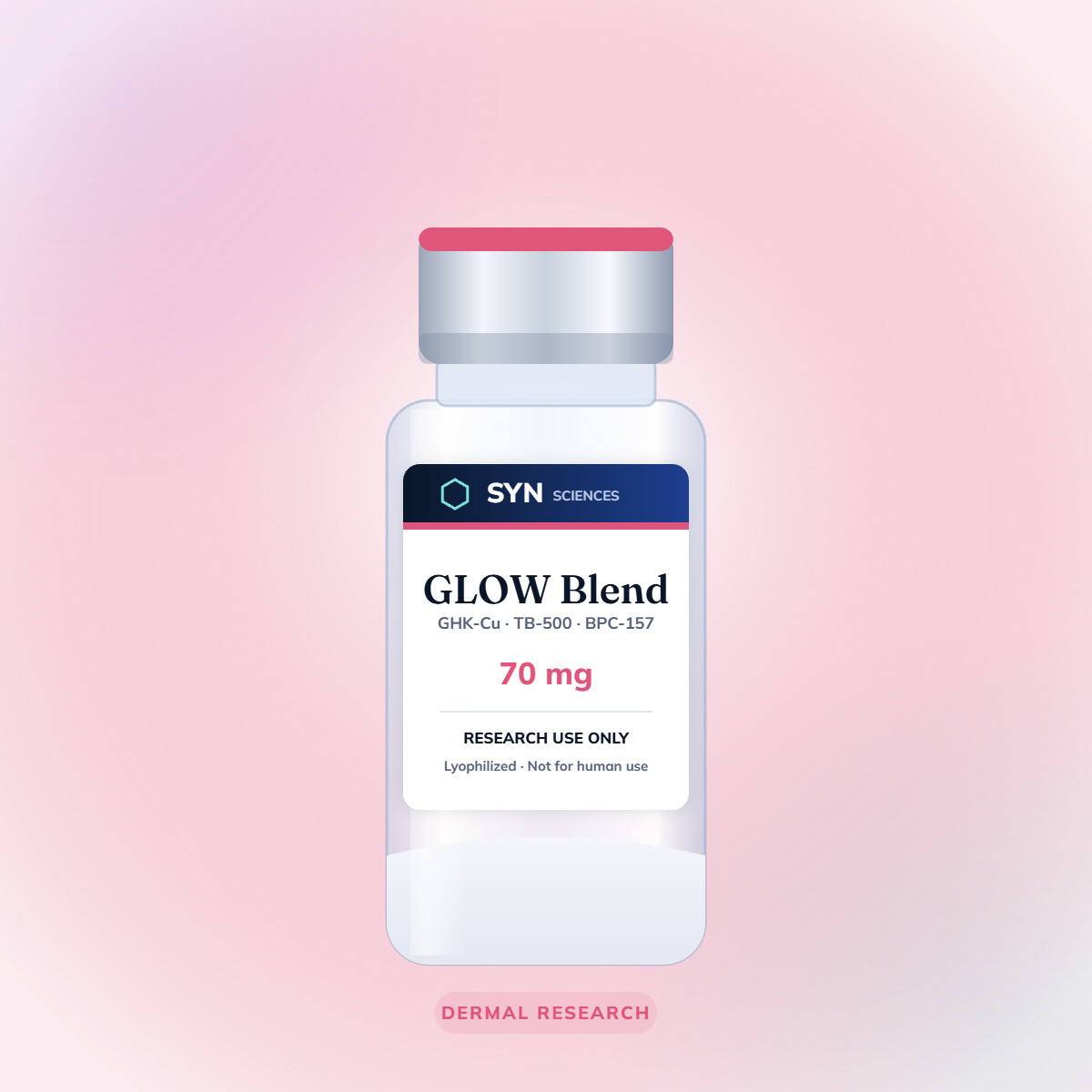
GLOW Blend
Research & Literature
Peer-reviewed preclinical studies, mechanism of action, and laboratory specifications. Technical content includes plain-language clarifications for accessibility.
Blend Profile
The GLOW Blend combines three research compounds in one vial: GHK-Cu, a copper(II) complex of the tripeptide Gly-His-Lys; TB-500, supplied as synthetic thymosin beta-4 (a 43-amino-acid actin-binding peptide); and BPC-157, a synthetic 15-amino-acid peptide. Each component has its own preclinical literature: GHK-Cu in extracellular-matrix and collagen research, thymosin β4 in actin regulation and cell migration, and BPC-157 in angiogenic (blood-vessel-forming) signaling.
No peer-reviewed study has evaluated this three-component combination. The only identified study of two of its components together (BPC-157 + TB-500 in a rat tendon model) found no added benefit over either peptide alone (Biçer et al., 2026). None of the components is approved by the FDA for any human or veterinary use.
Proposed Mechanisms of Action
The activities below were described for each component individually in peer-reviewed preclinical literature. None has been established for the combination.
- 01GHK-Cu · Collagen and Matrix Remodeling GHK-Cu stimulated collagen synthesis in fibroblast cultures (Maquart et al., 1988) and increased MMP-2 together with its inhibitors TIMP-1 and TIMP-2 (Siméon et al., 2000).Plain meaning: In lab-grown connective-tissue cells, it raised production of collagen and of the enzymes that remodel tissue scaffolding.
- 02GHK-Cu · Copper Transport GHK binds Cu(II) with high affinity and has been proposed to deliver copper to cells, where it is a cofactor for repair-related enzymes (Pickart et al., 2018).Plain meaning: It may carry copper to cells, which certain repair enzymes need.
- 03TB-500 · Actin Sequestration Thymosin β4 binds monomeric G-actin via its LKKTETQ motif, regulating cytoskeletal remodeling and cell migration (Goldstein et al., 2005).Plain meaning: It controls the supply of building blocks cells use to change shape and move.
- 04BPC-157 · VEGFR2–Akt–eNOS Signaling In endothelial cell and rat hind-limb ischemia models, BPC-157 was associated with VEGFR2 activation and Akt–eNOS signaling (Hsieh et al., 2017).Plain meaning: In animal and cell studies, it switched on a receptor linked to new blood vessel growth.
- 05BPC-157 · FAK–Paxillin and Cell Migration In tendon fibroblast cultures, BPC-157 promoted cell outgrowth, survival, and migration via the FAK–paxillin pathway (Chang et al., 2011).Plain meaning: In lab-grown tendon cells, it helped cells survive and move.
No interaction between GHK-Cu, thymosin β4, and BPC-157 has been studied. Mechanisms listed here come from separate cell and animal studies of each compound and have not been confirmed in humans. A combination of compounds may not behave like the sum of its parts.
Sources & References
Peer-reviewed preclinical and pilot research
Effects of BPC-157 and TB-500 on Achilles tendon healing in rats: A histopathological and biomechanical study
View SourceSafety and Efficacy of Approved and Unapproved Peptide Therapies for Musculoskeletal Injuries and Athletic Performance
View SourceRegenerative and Protective Actions of the GHK-Cu Peptide in the Light of the New Gene Data
View SourceThymosin beta4: actin-sequestering protein moonlights to repair injured tissues
View SourceEmerging Use of BPC-157 in Orthopaedic Sports Medicine: A Systematic Review
View SourceStimulation of collagen synthesis in fibroblast cultures by the tripeptide-copper complex glycyl-L-histidyl-L-lysine-Cu2+
View SourceThe tripeptide-copper complex glycyl-L-histidyl-L-lysine-Cu2+ stimulates matrix metalloproteinase-2 expression by fibroblast cultures
View SourceTherapeutic potential of pro-angiogenic BPC157 is associated with VEGFR2 activation and up-regulation
View SourceThe promoting effect of pentadecapeptide BPC 157 on tendon healing involves tendon outgrowth, cell survival, and cell migration
View SourceThymosin beta4 activates integrin-linked kinase and promotes cardiac cell migration, survival and cardiac repair
View SourceThymosin beta4 accelerates wound healing
View Source| Product Name | GLOW Research Blend |
|---|---|
| Composition | GHK-Cu 50 mg + TB-500 (thymosin β4) 10 mg + BPC-157 10 mg |
| Total Content | 70 mg per vial |
| GHK-Cu | Gly-His-Lys · Cu(II) · ≈ 403.9 g/mol |
| TB-500 Sequence | Ac-SDKPDMAEIEKFDKSKLKKTETQEKNPLPSKETIEQEKQAGES |
| TB-500 MW | 4963.5 g/mol |
| BPC-157 Sequence | Gly-Glu-Pro-Pro-Pro-Gly-Lys-Pro-Ala-Asp-Asp-Ala-Gly-Leu-Val |
| BPC-157 MW | 1419.5 g/mol |
| Purity | ≥ 99% per component by HPLC |
| Identity | Confirmed by mass spectrometry (see batch COA) |
| Form | Co-lyophilized powder |
| Solubility | Sterile water, PBS |
| Storage (Lyophilized) | −20°C, protected from light and moisture |
| Storage (In Solution) | 2–8°C, per laboratory protocol |
| Intended Use | In-vitro laboratory research and scientific study only |
| Regulatory Status | Not FDA approved for human or veterinary use |
Certificate of Analysis
SYN Sciences uses independent third-party analytical testing (Janoshik Analytical) to verify the identity and purity of GLOW Blend. Certificates of Analysis report HPLC purity and mass spectrometry identity results and are posted to the COA Library as they become available for each batch.
Batch Number: Listed on vial label and batch COA
View COA LibraryNeed the COA for your specific batch? Email support@synpeptidesciences.com with your order number and we will send the analytical report.