
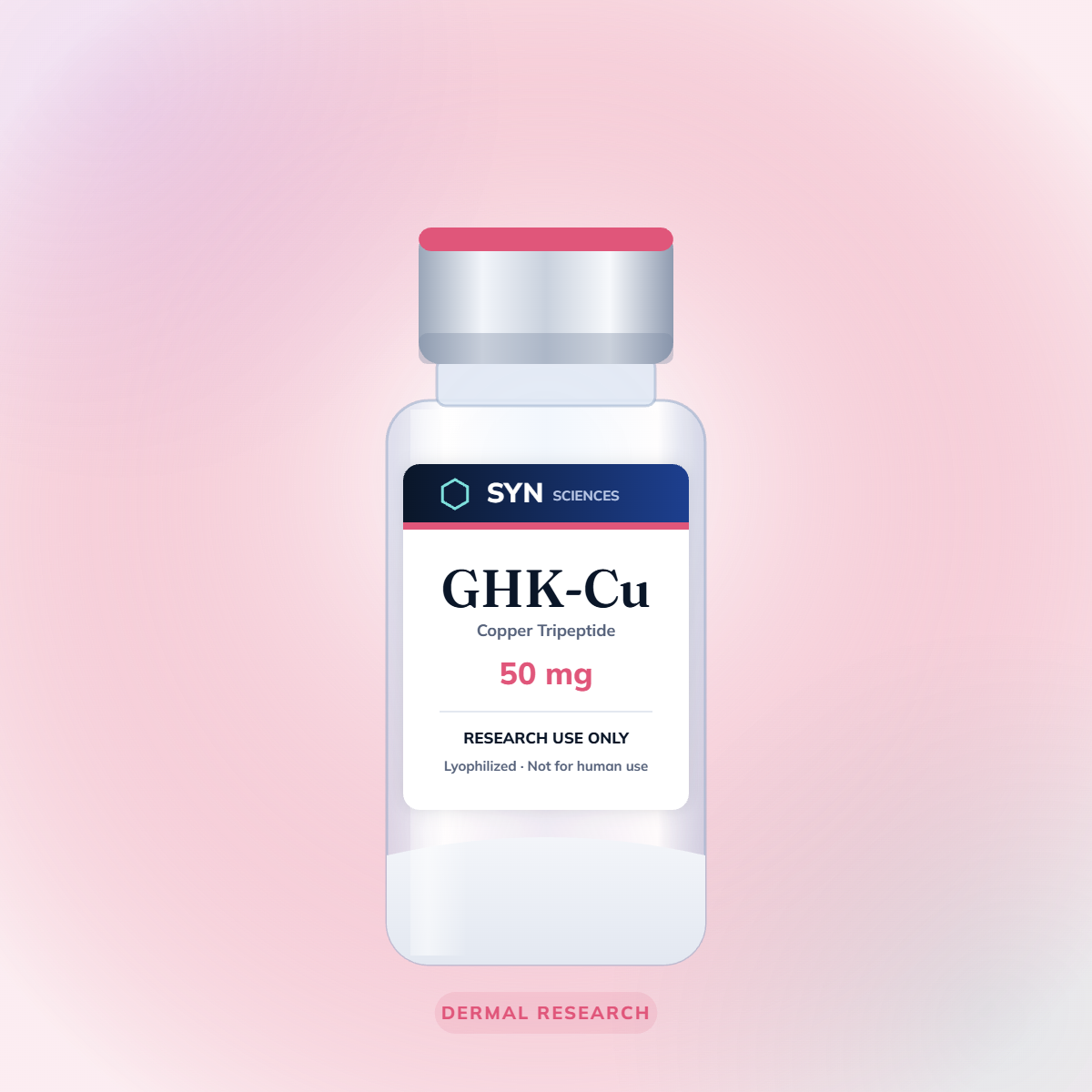
GHK-Cu
Research & Literature
Peer-reviewed preclinical studies, mechanism of action, and laboratory specifications. Technical content includes plain-language clarifications for accessibility.
Compound Profile
GHK-Cu is a complex of the tripeptide glycyl-L-histidyl-L-lysine (GHK) (a chain of just three amino acids) bound to a copper(II) ion. GHK was first identified in human plasma in 1973 as a factor that prolonged the survival of cultured liver cells (Pickart and Thaler, 1973), and it has a high affinity for copper (it binds copper tightly and can carry it).
Preclinical research has examined GHK-Cu in in-vitro (cell culture) studies of collagen and glycosaminoglycan synthesis and extracellular-matrix remodeling, and in in-vivo (animal) wound and connective-tissue models. GHK is also used as an ingredient in topical cosmetic products, but GHK-Cu is not approved by the FDA as a drug for any human or veterinary use.
Proposed Mechanisms of Action
The following activities have been described in peer-reviewed preclinical literature. Each entry includes a plain-language explanation.
- 01Collagen Synthesis GHK-Cu stimulated collagen synthesis in fibroblast cultures at nanomolar concentrations (Maquart et al., 1988).Plain meaning: In lab-grown connective-tissue cells, it increased production of collagen, the main structural protein in skin.
- 02Matrix Metalloproteinase Regulation GHK-Cu stimulated MMP-2 expression together with its inhibitors TIMP-1 and TIMP-2 in fibroblast cultures, consistent with a role in balanced matrix remodeling (Siméon et al., 2000).Plain meaning: It affected both the enzymes that break down old tissue scaffolding and the proteins that keep those enzymes in check.
- 03Glycosaminoglycan Modulation In experimental wound models, GHK-Cu modulated the expression of glycosaminoglycans and small proteoglycans such as decorin (Siméon et al., 2000).Plain meaning: It changed levels of the gel-like molecules that fill the space between cells in healing tissue.
- 04Copper Transport GHK binds Cu(II) with high affinity and has been proposed to deliver copper in a non-toxic form to cells, where copper is a cofactor for enzymes such as lysyl oxidase (Pickart et al., 2018).Plain meaning: It may act as a carrier that brings copper to cells, which certain repair enzymes need to work.
- 05Gene-Expression Signatures Analyses of public gene-expression datasets (Broad Institute Connectivity Map) suggested GHK shifts the expression of many human genes, including genes involved in tissue remodeling and antioxidant responses (Pickart et al., 2018).Plain meaning: Computer analyses of cell data suggest GHK may switch many genes up or down — a hypothesis that still needs direct testing.
Much of the GHK-Cu literature, including the gene-expression analyses, comes from a small number of research groups, and several mechanisms are inferred from cell culture or database analyses rather than controlled experiments. In a rat ligament-reconstruction model, effects of GHK-Cu were transient (Fu et al., 2015). Findings have not been confirmed to translate to humans.
Sources & References
Peer-reviewed preclinical and pilot research
Regenerative and Protective Actions of the GHK-Cu Peptide in the Light of the New Gene Data
View SourceThe human tripeptide GHK-Cu in prevention of oxidative stress and degenerative conditions of aging: implications for cognitive health
View SourceThe human tri-peptide GHK and tissue remodeling
View SourceTopically applied GHK as an anti-wrinkle peptide: Advantages, problems and prospective
View SourceSafety and Efficacy of Approved and Unapproved Peptide Therapies for Musculoskeletal Injuries and Athletic Performance
View SourceTripeptide in human serum which prolongs survival of normal liver cells and stimulates growth in neoplastic liver
View SourceStimulation of collagen synthesis in fibroblast cultures by the tripeptide-copper complex glycyl-L-histidyl-L-lysine-Cu2+
View SourceThe tripeptide-copper complex glycyl-L-histidyl-L-lysine-Cu2+ stimulates matrix metalloproteinase-2 expression by fibroblast cultures
View SourceExpression of glycosaminoglycans and small proteoglycans in wounds: modulation by the tripeptide-copper complex glycyl-L-histidyl-L-lysine-Cu(2+)
View SourceTripeptide-copper complex GHK-Cu (II) transiently improved healing outcome in a rat model of ACL reconstruction
View Source| Compound Name | GHK-Cu (Copper Tripeptide; glycyl-L-histidyl-L-lysine–Cu²⁺) |
|---|---|
| Chemical Class | Tripeptide–metal complex |
| Amino Acid Sequence | Gly-His-Lys complexed with Cu(II) |
| Molecular Formula | C₁₄H₂₄N₆O₄ · Cu |
| Molecular Weight | ≈ 403.9 g/mol |
| Purity | ≥ 99% by HPLC |
| Identity | Confirmed by mass spectrometry (see batch COA) |
| Form | Lyophilized blue to blue-violet powder |
| Vial Contents | 50 mg per vial |
| Solubility | Sterile water, PBS |
| Storage (Lyophilized) | −20°C, protected from light and moisture |
| Storage (In Solution) | 2–8°C, per laboratory protocol |
| Intended Use | In-vitro laboratory research and scientific study only |
| Regulatory Status | Not FDA approved as a drug for human or veterinary use |
Certificate of Analysis
SYN Sciences uses independent third-party analytical testing (Janoshik Analytical) to verify the identity and purity of GHK-Cu. Certificates of Analysis report HPLC purity and mass spectrometry identity results and are posted to the COA Library as they become available for each batch.
Batch Number: Listed on vial label and batch COA
View COA LibraryNeed the COA for your specific batch? Email support@synpeptidesciences.com with your order number and we will send the analytical report.