
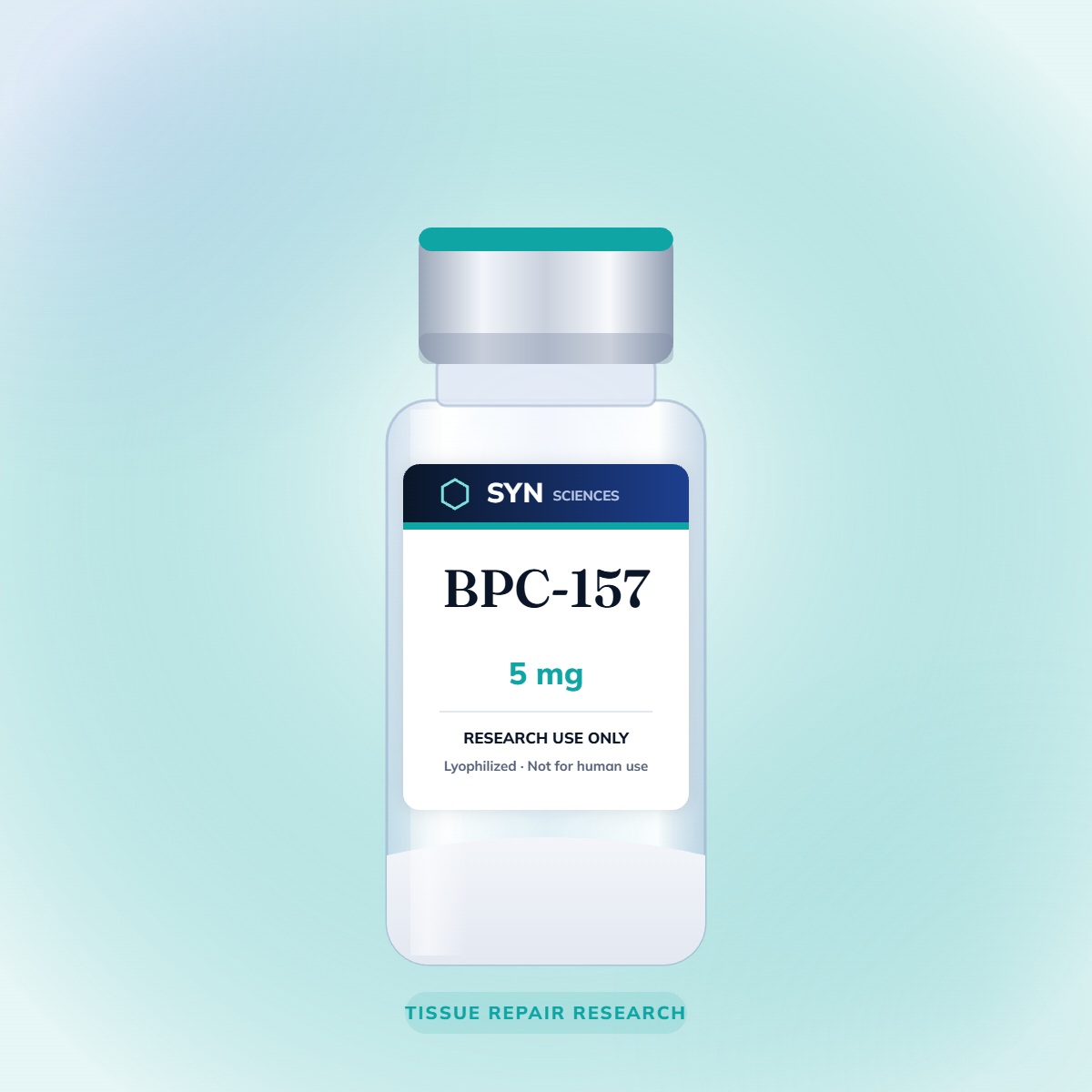
BPC-157
Research & Literature
Peer-reviewed preclinical studies, mechanism of action, and laboratory specifications. Technical content includes plain-language clarifications for accessibility.
Compound Profile
BPC-157 is a synthetic pentadecapeptide — a chain of 15 amino acids derived from a partial sequence of the body protection compound (BPC) originally isolated from human gastric juice. First characterized by Sikiric and colleagues in the early 1990s, BPC-157 is one of the most extensively studied regenerative peptides in preclinical research.
The compound is notably stable in aqueous solutions — water-based environments and gastric juice. It demonstrates measurable activity in a wide range of in-vitro (test tube) and in-vivo (in living animals) studies. BPC-157 is currently not approved by the FDA for human therapeutic use; all research applications are restricted to laboratory and preclinical investigation.
Three small human pilot studies have been published as of 2025, examining intravenous safety, intra-articular use in the knee, and interstitial cystitis. These pilot studies involved fewer than 30 total subjects across all trials and lacked placebo controls. Large-scale randomized human trials have not been completed.
Proposed Mechanisms of Action
The following pathways have been proposed in preclinical literature. Findings come primarily from animal and cell-culture studies; human translation has not been established.
-
01
Angiogenic Signaling Upregulation of vascular endothelial growth factor (VEGF) and VEGFR2 expression, promoting endothelial cell migration and new vessel formation in tissue repair models.Plain meaning: In animal studies, BPC-157 was associated with new blood vessel growth at injury sites — which delivers more nutrients to repairing tissue.
-
02
Nitric Oxide System Modulation Interaction with the eNOS pathway via Src-Caveolin-1 phosphorylation, modulating vasomotor tone and microvascular response.Plain meaning: The compound interacts with the body’s blood-vessel-tone control system, which regulates blood flow and inflammation response.
-
03
Growth Hormone Receptor Expression Dose-dependent upregulation of growth hormone receptor mRNA and protein in tendon fibroblasts (in-vitro), enhancing fibroblast proliferation in animal models.Plain meaning: In rat tendon cells, BPC-157 increased the number of receptors that respond to growth hormone — a possible mechanism for tendon healing observed in animals.
-
04
FAK-Paxillin Pathway Modulation of focal adhesion kinase signaling, a pathway involved in cell migration and tissue remodeling.Plain meaning: Influences a cellular signaling system that controls how cells move and rebuild damaged tissue.
-
05
Cytokine Modulation In animal cancer-cachexia models, observed counteraction of pro-inflammatory cytokines including IL-6 and TNF-α.Plain meaning: In animal studies, BPC-157 reduced certain inflammation-signaling proteins.
A substantial portion of BPC-157 preclinical literature originates from a single research group. Independent replication remains limited. The mechanisms above describe pathways observed in animals and cells — they have not been confirmed to operate identically in humans. Researchers are encouraged to consult primary sources for a complete and balanced view.
Sources & References
Peer-reviewed preclinical and pilot research
Emerging Use of BPC-157 in Orthopaedic Sports Medicine: A Systematic Review
View SourceRegeneration or Risk? A Narrative Review of BPC-157 for Musculoskeletal Healing
View SourceSafety and Efficacy of Approved and Unapproved Peptide Therapies for Musculoskeletal Injuries and Athletic Performance
View SourceBPC 157 Therapy: Targeting Angiogenesis and Nitric Oxide’s Cytotoxic and Damaging Actions, but Maintaining, Promoting, or Recovering Their Essential Protective Functions. Comment on Józwiak et al. Multifunctionality and Possible Medical Application of the BPC 157 Peptide-Literature and Patent Review. Pharmaceuticals 2025, 18, 185
View SourceTherapeutic potential of pro-angiogenic BPC157 is associated with VEGFR2 activation and up-regulation
View SourceModulatory effects of BPC 157 on vasomotor tone and the activation of Src-Caveolin-1-endothelial nitric oxide synthase pathway
View SourceThe promoting effect of pentadecapeptide BPC 157 on tendon healing involves tendon outgrowth, cell survival, and cell migration
View SourcePentadecapeptide BPC 157 enhances the growth hormone receptor expression in tendon fibroblasts
View SourceGastric pentadecapeptide BPC 157 accelerates healing of transected rat Achilles tendon and in vitro stimulates tendocytes growth
View SourceSafety of Intravenous Infusion of BPC157 in Humans: A Pilot Study
View SourceIntra-Articular Injection of BPC 157 for Multiple Types of Knee Pain
View Source| Compound Name | BPC-157 (Body Protection Compound 157) |
|---|---|
| Chemical Class | Synthetic pentadecapeptide |
| Amino Acid Sequence | Gly-Glu-Pro-Pro-Pro-Gly-Lys-Pro-Ala-Asp-Asp-Ala-Gly-Leu-Val |
| Molecular Formula | C₆₂H₉₈N₁₆O₂₂ |
| Molecular Weight | 1419.55 g/mol |
| CAS Number | 137525-51-0 |
| PubChem CID | 71309494 |
| Purity | ≥ 99% by HPLC |
| Form | Lyophilized white to off-white powder |
| Vial Contents | 5 mg net peptide content per vial |
| Solubility | Sterile water, PBS |
| Storage (Lyophilized) | −20°C, protected from light, sealed vial |
| Storage (In Solution) | 2–8°C; use within recommended laboratory protocol |
| Stability | Stable in aqueous solution and gastric juice (in-vitro) |
| Half-Life (animal models) | < 30 minutes (per Vasireddi et al., 2025) |
| Intended Use | In-vitro laboratory research and scientific study only |
| Regulatory Status | Not FDA approved for human or veterinary use |
Certificate of Analysis
SYN Sciences uses independent third-party analytical testing (Janoshik Analytical) to verify the identity and purity of BPC-157. Certificates of Analysis report HPLC purity and mass spectrometry identity results and are posted to the COA Library as they become available for each batch.
Batch Number: Listed on vial label and batch COA
View COA LibraryNeed the COA for your specific batch? Email support@synpeptidesciences.com with your order number and we will send the analytical report.